An email popped into my inbox which I was so happy to receive (something I cannot say about some of them!). It was from LiDAR, the digital terrain mapping people. Not only was it exciting to have something that we have long known confirmed, but it also gave us additional information about why certain energies were placed where they were.
Many years ago, in 2006, Chris and I spent time exploring Salisbury Plain, doing energy-work with the barrows (burial Mounds), and the Cursus. During this exploration, I was given a glimpse of the Bronze Age people who served the temple, and the Mother Goddess. (It would be useful to read this for context).
At the time we received the information, which came in the form of inner-vision and telepathic understanding, I had no way of verifying the existence of the spring we had seen on the previous occasion, or why the Initiatic gateway was along the cursus and not in the circle of Stones (Stonehenge). But, having received the email from LiDAR, I was excited to see that my intuitive vision was correct, at least as far as the Spring is concerned.

This is how the LiDAR people put it (and rather beautifully, I thought):
“The LiDAR image unfurls a captivating tapestry, revealing the profound significance of Stonehenge’s position. No longer a mere coincidence, its placement appears divinely orchestrated, guided by an ancient wisdom that intertwined the monument with the very essence of the land. Observe the enigmatic “avenue,” a mysterious earthwork extending from the henge itself. It stretches forward, seemingly guided by an otherworldly force, tracing an invisible path toward the fateful convergence of these long-lost waterways. What hidden meaning lies within this alignment? What cosmic forces were at play when this extraordinary design was conceived?
“The Stonehenge, the cursus, and the ancient river channels intertwine in a symphony of celestial geometry and earthly harmony. The landscape becomes a living tapestry, where the past whispers its secrets, waiting to be deciphered by those who dare to seek the truth.

“What does this profound relationship signify? Could it be a celestial map etched upon the Earth’s canvas, guiding ancient minds to comprehend the mysteries of the cosmos? Or does it hold the key to forgotten rituals and sacred ceremonies, enacted by our ancestors in harmony with the celestial and terrestrial realms?
“The LiDAR images, combined with historical mapping, grant us an extraordinary glimpse into the past, igniting our curiosity and fueling our imagination. It invites us to explore the profound interplay between humanity and the landscape, where Stonehenge emerges as a portal to a realm of ancient knowledge and cosmic connection.
“So, let us embark on a journey of discovery, armed with the LiDAR’s revelations and the courage to unravel the enigmatic relationship between Stonehenge, the coursing rivers of old, and the mystical cursus. With each step, we inch closer to unearthing the profound truths that lie dormant within these sacred grounds.
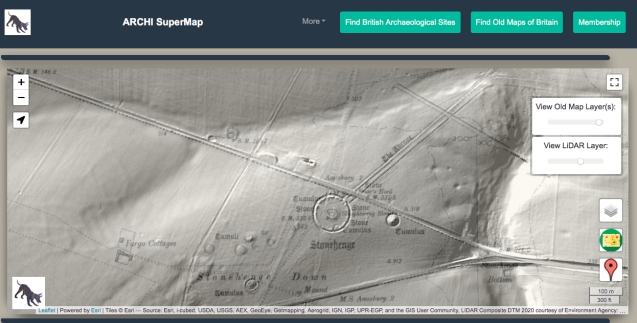
“The mysteries await your arrival, dear seeker of knowledge. Unlock the secrets of Stonehenge and immerse yourself in the mesmerizing dance between monument, landscape, and the enigmatic forces that shaped our ancient past.”
I mean, could they have put it any better?
According to what I saw in that ‘memory’, the rivers were no longer there. On the surface, at least. But the bournes (or springs) still rose, giving them water; but perhaps only at certain times of the year when the, now, underground channels filled up after a long rainy season. (These rivers were obviously much wider than the river Avon, where Durrington Walls was built close to).
By the time Stonehenge was built, there may have been only winter rivers, but this would still have been seen as a gift of fertility from the Mother to humankind.
Many years ago, when I worked in post-excavation in Winchester, before the new council chairman got rid of the Winchester Archaeology team, a skull and longbones of a Neolithic woman came in to be cleaned up. Her bones had lain in a long barrow, near Barton Stacey, and rescued before the barrow had been completely ploughed out. I was given permission to explore them, so, using psychometry I tuned into the skull of this ancient woman.

From the images that came into my head, I gathered that she was the head priestess of a group of people who lived there six thousand years ago, and part of her role was to care for the spring close to their settlement. She placed flowers there, at particular times of the year, and made sure it was clear, clean and energetically active. She had a daughter, which her own mother, the girl’s grandmother, took care of. The woman herself had responsibility for the welfare, both spiritual and physical, of the tribal unit and was too busy to teach her daughter. Instead, the role fell to her mother who trained the child in all the ways of the priestess so she could take her mother’s role when the time came for her to do so. This seemed to be the way they did things. Grandmother taught the granddaughter, freeing up the mother.

This was fascinating because it gave me a wonderful insight into how the matrilineal knowledge was passed down. It also highlighted the importance placed on the sacred springs. However, at the time, I was not aware of any springs around Barton Stacey. I mentioned it to my then brother-in-law, who told me there was a winter-bourne in the field (Belonging to Cocum Farm) across from where the long barrow once stood. In very wet winters, this bourne still rises in the field and runs down to the River Dever where it joins it.
The old stories tell of the Maidens of the Wells, spirit women who guard the sacred springs. I imagine the stories are part of our collective memory, reminding us of a time when we honoured the waters that fertilised our lands and gave us food to eat. It is interesting too, to see that the rituals of the Neolithic remained in the Bronze Age, and still remain today, albeit in a different form.
Apart from this lovely confirmation of previous intuitions, I was also struck by the fact that at Stonehenge, the large energetic gateway was immediately on top of where the rivers originally divided.
If you are sensitive enough you will feel the energy of water as you pass over it, or get close to it. It has a very recognisable feel. The gate’s placement over where the river divided, might have been planned, or they may have simply felt the water energy below. We now need dowsers to find this water, but I know that it can be psychically experienced too, although dowsing is a great way to learn sensitivity.
The energetic gateway we perceived might have been an energy, built up over years of working with the place, in a sacred way. The gateway itself seems to be at one junction and the stone circle avenue at the other. (The gate is the pink triangle, and the blue circle is the site of the spring). The gateway might also have energised the flow of water as it passed close to the circles, on its way to the sea, like the River Avon close by.

Tom Graves‘ books tell us that many stone circle sites were built on underground water channels – as were Cathedrals and old churches. Tom was a dowser and did amazing work at many sacred sites, mapping out the energies of the stones, and their placement over water channels deep in the earth. His work opened the doors of understanding around how our ancestors ensured the survival of their community while honouring the earth. His books are well worth the read.

In doing these explorations into the past, we are relearning the ways our ancestors placed their sites and how they worked with them. In many ways, we are intuitively doing the same when we dress the wells and hang ribbons on ancient trees. The knowledge is in the landscape, and all of it is accessible. All we have to do is become sensitive enough to feel it and then act on what we perceive. Even if it seems like we are making it up. Because, when another technology finds the same information, it is so wonderfully affirming.
Try it out for yourself, if you ever have the chance to go to Salisbury Plain. I might have to go back myself … if ever I have the time…






 The Gaia Method Earthways