On June the 8th, with some time to spare, I paid a short visit to St Peter’s Church, or what is left of it. It sits in a lovely, green graveyard beside a pub, alongside the old main route to London, through Romsey. The original church is recorded in the Domesday book, so in its beginning it was probably a typical Saxon church constructed of wood before being rebuilt with stone. Some of the masonry from that older Saxon church was incorporated into the later church of St Peter, which was built in the 12th Century. You can read the history here.
That’s the back story.
(I’ve done work in this little church before, once with a healing group I was running back in the 2000’s, so I knew it well enough. Although I hadn’t visited it since then).
Today, everything was verdant and pretty, and the graveyard beautifully tended. Seats, placed in mown grassy areas, created a little oasis of peace. Perhaps the sense of peace was because this was where the original nave once stood and people for centuries have worshipped and prayed here. I could have quite happily spent hours sitting here, as it felt like a little oasis, but I satisfied myself by wandering about and taking photos instead.
But as I approached the main door, I was ‘instructed’ to walk around the church anti-clockwise. When I had done that, I was told to do it again, and then a third time. Each time I repeated the circuit, I felt myself going deeper into the layers of energy, each circuit opening into a deeper level.
Once inside, I went, as usual, to stand at the altar but I was instructed to stand facing the entrance door (I forgot when doing this that the tiny church was originally part of a bigger one). I remember doing this in Crawley too. Thinking I was supposed to stand facing the altar, but instead, I was instructed to go to a point in the nave. There are distinct energy points down the centre of most churches/cathedrals, as if the structure represents a human body, with either its chakra points or the three Tan Tien. It all depends on which system you use. For me, it is usually the three Tan Tien (even though they are also within the seven chakra system).
As I tuned in, I found the Ruby ray being anchored there, but it was connecting to the Diamond level of the Earth’s Energy field. Next, I turned and faced the Altar and there the emerald ray descended, but it was connected to the Amethyst layer.
With my back to the altar again, I felt the urge to turn to the north and found myself anchoring a line horizontally, to another site. It felt like it was connecting to a church, which I discovered later, was St Mary’s Church at Longstock. Once that was anchored, I turned to face the opposite direction, to what again felt, was another church. This tim, St. Peter’s and St Pauls at King’s Sombourne.
Again, I had to turn. This time to the west. This line seemed to go quite far and I wasn’t picking up a churchy feeling. Only later, when I went on google earth, did I make the line connection to Figsbury Ring, where we had anchored a white flame many years ago.
My last turn was towards the east, and this time the line was shorter, and led to Woolbury hillfort; another place where we had done year’s worth of energy activations. Both the sites on this line were pre-Christian, but the other two were Christian. Yet, joined together, they created the shape of a cross. Connecting two ancient belief systems.
In all levels of this energy-work, there is a cross-over of times and energies: Pagan and Christian. This seems to be happening so much lately that it really must be time for old beliefs in the Mother to be married to the current male beliefs of Father. (This has nothing to do with gender identity. This simply means the belief in the feminine and masculine aspects of creation which any one person, male or female, or any other identification, can embody).
The Diamond and Ruby, both part of the second sphere, are male and female respectively. The emerald of the first sphere; landscape and vegetation was now anchored to the higher, amethyst level of spiritual thoughtforms. Perhaps this is because we need to understand nature from a higher perspective so we can do what the land needs, not what we think it needs.
But it may mean something completely different.
Figsbury Ring has been used, since the Neolithic period, as a sacred site related to the fertility of the land, and using sacred ceremony in a gathering place for the ancestors of these isles. Woolbury Hillfort (or camp) is Iron Age but was also used during the Bronze Age. It was a place of sanctuary during raids, and also a place where wheat could be stored and distributed during less productive years (these are my experiences, not necessarily archaeological theory. I have worked with both these sacred sites, so already have their energy in my memory banks).
Both the prehistoric sites involved the sanctity of grain and used fertility rites to ensure a good harvest. The two churches were also gathering places, but they have their focus on Father, whereas the prehistoric sites had the focus on Mother/Earth and Father/Sun.
The interplay of the different levels within differing time periods is interesting, and also the cross-over of crystalline energies. It feels like levels, and energies are being wedded together in the present, but with the intention of influencing the future.
Hopefully, in a future life, I can see how this has all worked out.
I haven’t visited the other two churches yet, but did go to Woolbury and activated the line to the Old St. Peter’s. Most of that visit was personal, and I received the necessary energies for work in southern Spain next year.
I will see what happens when I go to Figsbury … which may take some time …
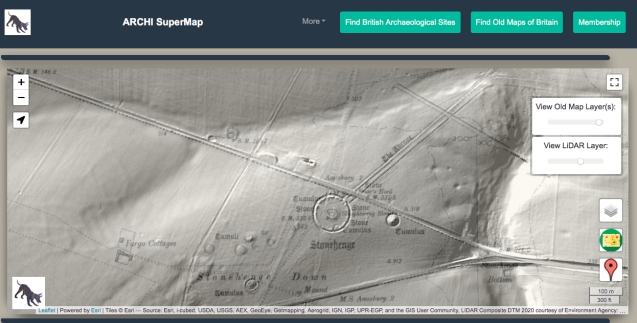
An email popped into my inbox which I was so happy to receive (something I cannot say about some of them!). It was from LiDAR, the digital terrain mapping people. Not only was it exciting to have something that we have long known confirmed, but it also gave us additional information about why certain energies were placed where they were.
Many years ago, in 2006, Chris and I spent time exploring Salisbury Plain, doing energy-work with the barrows (burial Mounds), and the Cursus. During this exploration, I was given a glimpse of the Bronze Age people who served the temple, and the Mother Goddess. (It would be useful to read this for context).
At the time we received the information, which came in the form of inner-vision and telepathic understanding, I had no way of verifying the existence of the spring we had seen on the previous occasion, or why the Initiatic gateway was along the cursus and not in the circle of Stones (Stonehenge). But, having received the email from LiDAR, I was excited to see that my intuitive vision was correct, at least as far as the Spring is concerned.
This is how the LiDAR people put it (and rather beautifully, I thought):
“The LiDAR image unfurls a captivating tapestry, revealing the profound significance of Stonehenge’s position. No longer a mere coincidence, its placement appears divinely orchestrated, guided by an ancient wisdom that intertwined the monument with the very essence of the land. Observe the enigmatic “avenue,” a mysterious earthwork extending from the henge itself. It stretches forward, seemingly guided by an otherworldly force, tracing an invisible path toward the fateful convergence of these long-lost waterways. What hidden meaning lies within this alignment? What cosmic forces were at play when this extraordinary design was conceived?
“The Stonehenge, the cursus, and the ancient river channels intertwine in a symphony of celestial geometry and earthly harmony. The landscape becomes a living tapestry, where the past whispers its secrets, waiting to be deciphered by those who dare to seek the truth.
“What does this profound relationship signify? Could it be a celestial map etched upon the Earth’s canvas, guiding ancient minds to comprehend the mysteries of the cosmos? Or does it hold the key to forgotten rituals and sacred ceremonies, enacted by our ancestors in harmony with the celestial and terrestrial realms?
“The LiDAR images, combined with historical mapping, grant us an extraordinary glimpse into the past, igniting our curiosity and fueling our imagination. It invites us to explore the profound interplay between humanity and the landscape, where Stonehenge emerges as a portal to a realm of ancient knowledge and cosmic connection.
“So, let us embark on a journey of discovery, armed with the LiDAR’s revelations and the courage to unravel the enigmatic relationship between Stonehenge, the coursing rivers of old, and the mystical cursus. With each step, we inch closer to unearthing the profound truths that lie dormant within these sacred grounds.
“The mysteries await your arrival, dear seeker of knowledge. Unlock the secrets of Stonehenge and immerse yourself in the mesmerizing dance between monument, landscape, and the enigmatic forces that shaped our ancient past.”
I mean, could they have put it any better?
According to what I saw in that ‘memory’, the rivers were no longer there. On the surface, at least. But the bournes (or springs) still rose, giving them water; but perhaps only at certain times of the year when the, now, underground channels filled up after a long rainy season. (These rivers were obviously much wider than the river Avon, where Durrington Walls was built close to).
By the time Stonehenge was built, there may have been only winter rivers, but this would still have been seen as a gift of fertility from the Mother to humankind.
Many years ago, when I worked in post-excavation in Winchester, before the new council chairman got rid of the Winchester Archaeology team, a skull and longbones of a Neolithic woman came in to be cleaned up. Her bones had lain in a long barrow, near Barton Stacey, and rescued before the barrow had been completely ploughed out. I was given permission to explore them, so, using psychometry I tuned into the skull of this ancient woman.
From the images that came into my head, I gathered that she was the head priestess of a group of people who lived there six thousand years ago, and part of her role was to care for the spring close to their settlement. She placed flowers there, at particular times of the year, and made sure it was clear, clean and energetically active. She had a daughter, which her own mother, the girl’s grandmother, took care of. The woman herself had responsibility for the welfare, both spiritual and physical, of the tribal unit and was too busy to teach her daughter. Instead, the role fell to her mother who trained the child in all the ways of the priestess so she could take her mother’s role when the time came for her to do so. This seemed to be the way they did things. Grandmother taught the granddaughter, freeing up the mother.
Barton Stacey Bourne.
This was fascinating because it gave me a wonderful insight into how the matrilineal knowledge was passed down. It also highlighted the importance placed on the sacred springs. However, at the time, I was not aware of any springs around Barton Stacey. I mentioned it to my then brother-in-law, who told me there was a winter-bourne in the field (Belonging to Cocum Farm) across from where the long barrow once stood. In very wet winters, this bourne still rises in the field and runs down to the River Dever where it joins it.
The old stories tell of the Maidens of the Wells, spirit women who guard the sacred springs. I imagine the stories are part of our collective memory, reminding us of a time when we honoured the waters that fertilised our lands and gave us food to eat. It is interesting too, to see that the rituals of the Neolithic remained in the Bronze Age, and still remain today, albeit in a different form.
Apart from this lovely confirmation of previous intuitions, I was also struck by the fact that at Stonehenge, the large energetic gateway was immediately on top of where the rivers originally divided.
If you are sensitive enough you will feel the energy of water as you pass over it, or get close to it. It has a very recognisable feel. The gate’s placement over where the river divided, might have been planned, or they may have simply felt the water energy below. We now need dowsers to find this water, but I know that it can be psychically experienced too, although dowsing is a great way to learn sensitivity.
The energetic gateway we perceived might have been an energy, built up over years of working with the place, in a sacred way. The gateway itself seems to be at one junction and the stone circle avenue at the other. (The gate is the pink triangle, and the blue circle is the site of the spring). The gateway might also have energised the flow of water as it passed close to the circles, on its way to the sea, like the River Avon close by.
Tom Graves‘ books tell us that many stone circle sites were built on underground water channels – as were Cathedrals and old churches. Tom was a dowser and did amazing work at many sacred sites, mapping out the energies of the stones, and their placement over water channels deep in the earth. His work opened the doors of understanding around how our ancestors ensured the survival of their community while honouring the earth. His books are well worth the read.
In doing these explorations into the past, we are relearning the ways our ancestors placed their sites and how they worked with them. In many ways, we are intuitively doing the same when we dress the wells and hang ribbons on ancient trees. The knowledge is in the landscape, and all of it is accessible. All we have to do is become sensitive enough to feel it and then act on what we perceive. Even if it seems like we are making it up. Because, when another technology finds the same information, it is so wonderfully affirming.
Try it out for yourself, if you ever have the chance to go to Salisbury Plain. I might have to go back myself … if ever I have the time…
I have worked, energetically, with stone circles for twenty years, but it was on a trip to the remains of a stone circle in Cumbria, deep in a forest plantation, that I was granted a wonderful insight into one way which our Bronze age ancestors used the circles.
From that experience, I understood that some circles were associated with maintaining fertility. They were used ritually at certain points of the year, (solstices, equinoxes, etc) and at that time priests, priestesses, and the entire community channelled the energy of the solar light into the circle to fertilise the wheat they had harvested the previous season, fertilising the waiting earth beneath; the masculine creative force of the sun, fertilising the female earth.
At the end of the Mesolithic period, ancient communities moved from hunting and gathering to growing and tending. Their focus was on the growing of food, therefore taking care of both the physical landscape and the energetic landscape meant they had a better chance of survival. Their awareness of the Oneness of life was a part of them. They did not simply live on the planet, separate to it as we do, but they understood they were an integral part of it.
But how did the Early Neolithic farmers begin to use stone to contain and hold the energies they built in the landscape? How did they learn that particular form of energy-work in the first place? I have found no evidence of fertility work of this nature in the earlier Mesolithic hunter-gatherers. It seemed to arrive with people who grew their food on a large scale and who needed specific energetic help to accomplish that.
Before agriculture, hunters worked shamanically to connect to the spirit of the animal they were about to hunt, communicating with it before the hunt and asking for, and acknowledging, the creature’s sacrifice to feed them. But, with the advent of agriculture, some of these practices changed. To the ancestor, everything was energy. Every living thing, including apparently inert objects, such as stone, soil, etc, had a spirit and therefore deserved respect and acknowledgement. (You only have to look at the current indigenous people of the world to see how our ancestors might have lived).
It has always been a mystery to me how practices changed, from hunting and gathering, to include the growing of crops. Once you begin to grow food, the process and focus changes. But when did they begin to associate stone circles with corn-energising rituals?
It was only while reading Home by Francis Pryor, that I found a possible answer. Francis had been working on a Neolithic causewayed enclosure site in Etton along with his wife. The enclosure was part of a complex of enclosures, like Salisbury Plain, and comprised a single circuit of interrupted ditches. They discovered, at the end of each ditch segment, objects which had been carefully placed there. The deposits in the segmented ditches were laid in layers, each protected by a birchbark mat, which would have been naturally waterproof. Intact pottery vessels, turned upside-down, skulls, and broken quern stones, for the grinding of grain into flour, were also placed in layers in the ditches.
Upright Saddle Quern Deposit.
According to Prior, the objects placed within the ditches were crafts traditionally carried out by women: pottery, weaving, bread-making, etc. That makes me wonder why they deposited these particular objects in the ditches? Was the site traditionally viewed as female? Just as with the Cumbrian circle? The female energy was believed to reside in the earth, so it makes sense that if they wanted to ensure the positive flow of energy into their own home and tribe they would make offerings of gratitude for the resources already received and the petition for that flow to continue for the coming year.
Quern stones at each side of causeway.
Within the henge, there were also multiple pits filled with ritual deposits, but the most striking thing for me was that in the ditches on either side of the causeways, quern stones had been placed on their sides, so that they stood upright. Stones were placed on either side of the causeway, of which there were possibly four, oriented North, South, East and West, although the South entrance was subsequently destroyed. The deposits seem to have been placed, on separate occasions, but in the same place each time, in layers, perhaps during large gatherings, and by kin groups. Each time they gathered, they carried out ceremonies and a new stone was placed there; again on its side so that it stood upright, but above the buried layer of the previous celebrations.
Grain was an important part of their survival and the excavators of Etton discovered evidence that “cereal crops were both grown and processed within the immediate vicinity, perhaps within the enclosure.”
Datchet causeway. Example of how ditches were spaced.
When I read this for the first time, it immediately reminded me of my visit to Cumbria. and the importance of the stone circle in charging the wheat for the following growing season. The deposition of saddle querns, upright in the ditches, signalled for me the mental leap made by the Neolithic communities from ritual deposits of stones for wheat-grinding to standing stones. Wheat was such an important part of their survival that it stood to reason that the objects associated with grain processing should be held in such sacred esteem. I imagine, through the deposition of these stones, each family was both manifesting their food for the coming year but also giving something back to the Mother, in gratitude for feeding them; for taking care of them. And, as the quote above suggests, if the site was used for the processing of wheat, then corn rituals might well have been carried out in the centre too, creating what later became, the stone circles.
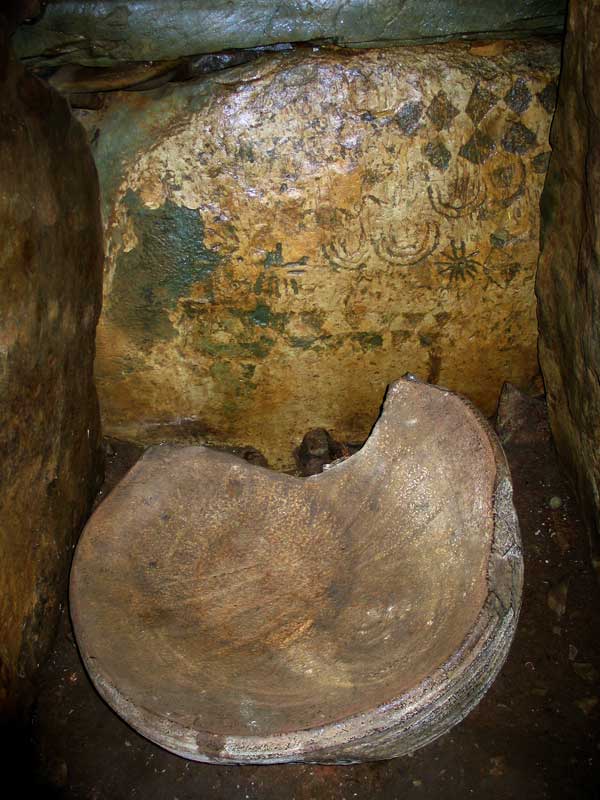
Knowth Basin.
In Knowth, there is the huge concave stone in one of the recesses within the burial mound. Burial mounds represent the womb of the Mother. Knowth is part of the Newgrange complex, where the sun enters the chamber at Midwinter, to light up the darkness within. Again the solar rays fertilising the Mother. The large concave stone is like a huge ceremonial saddle quern and may well symbolise the fertilising of the grain. A gift to the mother and holder of the ashes of people who may have been the ones who carried out the sacred ceremonies.
The carving inside the stone is interesting too: To me, it looks like an energetic representation of the solar rays fertilising the seed within the womb of Mother Earth.
Knowth Inner carving.
Of course, it may have had multiple meanings. As modern humans, we see symbols as representing things we only have understanding of ‘in the present’. We see things one-dimensionally. Our ancestors may have had access to knowledge we can only imagine, or re-learn, as we work in the energetic landscapes of the Mother.
The positioning of the saddle querns in the site in Etton also made me think of Mecca, where before Islam, tribal communities gathered there yearly. Each tribe had its own stone statue representing the energy of their tribe, their over-ruling deity, part of a circle of stones around the sacred site. Only with the coming of Islam was this practice destroyed and now only the ruling family have their ‘stone’, contained in the Kaaba. (Mecca had been a sacred site for many centuries, sacred to a triple goddess. One of these goddesses, Al-Uzzah, was a grain goddess).
Old Mecca.
As I was writing this, I found this very interesting article: https://www.hunebednieuwscafe.nl/2017/10/british-stone-circles-were-used-for-parties/ The article states: The research into the Ring of Brodgar also showed that each stone comes from a different part of the Orkney Islands. Apparently, each of the diverse groups of people brought its own stone and placed it in the monument. Remarkably, Professor Bayliss’ research also found evidence that people travelled to the Orkneys from as far away as Belgium. This fits very well with the idea of family groups/tribes having their quernstone in the circle.
Many ancient Mother/Goddess sites were symbolic womb; places where, at certain times of the year, the energies of fertility were strongest. The midwinter ritual of the sun piercing the darkest recesses of burial mounds, and temples, were fertility processes: the male sun sending his fertilising principle into the dark womb of the Mother to activate the egg waiting there. These were no empty rituals, however. Our ancestors understood the active energies that revitalised the energy lines in the earth, that brought new vitality after the dark of winter, warming the earth; bringing new growth. Where energy flows, so too does life.
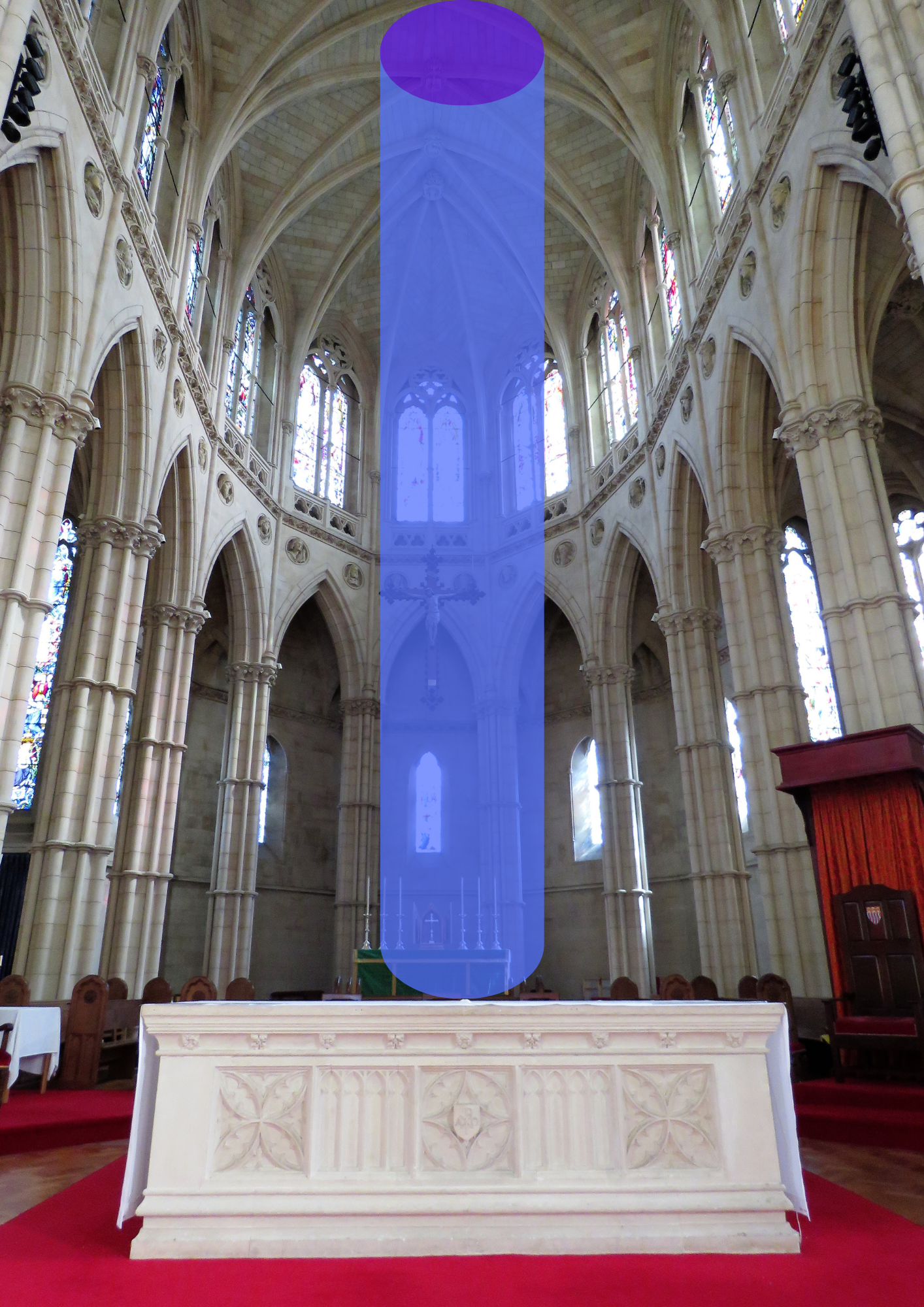
There are naturally powerful places on earth where the energy is palpable, such as volcanos, places where crystals have formed, and deep underground caves. Places too where elemental energies are strong: rivers, lakes, mountains, and forests. But energy is also built through ritual and intention. I have never been a ‘ritual’ worker. I never really understood the purpose of ritual except as a focus for creating and for intention. But, I recently had an experience in a Cathedral Church in Arundel where I saw the result of ritual actions on the energy of a place over time.
We were working on making a triangular connection between the sea and the river Arun. I wasn’t sure where this connection was supposed to be anchored but we went into the cathedral, just in case. I had been given water energy by a wonderfully loving sea elemental on Littlehampton beach and although I knew I had to put it somewhere; I didn’t know where, until it happened. As I approached the altar, which was built on top of an ancient spring, I saw the blue column of light behind it, which had been built up over the years by the priests doing the bread and wine ritual. This was a surprise to me. The energy had built up over so many years and had created a healing channel in the cathedral. This is also where the water energy gift was anchored, which was also a huge surprise. (One of the important things to remember when doing energywork is that religious belief plays no part. It is the positive intentions to help humanity which are important. Although saying that, the ancientness of the catholic ritual contains an energy that I have not found in other, more modern religious rituals).
But this ritual also involves the energising of bread, just as the ancient ritual in the stone circle Cumbria showed. (I think the energising of the wine might have been Roman in origin and added later as patriarchal religions became more prominent. The wine is energised from ‘above’ whereas the bread should be energised by the mother-energy ‘below’).
So that brings us back to the quernstones. We know that causewayed enclosures were the forerunners of stone circles so if the quernstones were placed as sacred objects and connected to a particular kin-group, (as in old Mecca, and Orkney), then it is not such a stretch to see that the later ‘standing stones’/quernstones in a circle came to represent each kin-family’s offerings to the Mother Goddess. The rituals building up over time gave these places their sanctity but there may well have been an extant ‘energy’ that told them where to build these sites in the first place.
The alignments of the main causeways appear to be directional, and the east/west entrances align with the sun. (We have often found main energylines crossing over in these sites, although not necessarily NSEW aligned). The astrological alignment aspects of stone circles might have come into play as a way for them to be sure about the timing of important events. I’m sure the simple beginning of the ritual circles became more complicated over time.
A very good book which explains how Glastonbury abbey was created is: The Gate of Remembrance by Frederick Bligh Bond, F.R.I.B.A. It is a book about the discovery of The Edgar Chapel through automatic writing and gives very interesting energetic information on how a sacred site is created.
On the 2nd of January, we felt an impulse to drive to Durrington Walls, near Stonehenge. It was our first trip to do energy-work in months and it felt really good to connect to the ancestors again. I had been weighed down by the darkness of winter, and the constant rain, and felt permanently rooted in modern life and its stresses having been in the UK for far longer than originally intended. As result, I had lost my focus, so the trip to Durrington felt like a positive step and as we drove there, feeling the intention, I remembered how much I loved doing this work.
Durrington Walls, Wiltshire.
When we arrived, we walked into the henge, looking with archaeological eyes at how the settlement had been constructed. We then tried to find the site of the two circles that originally lay within it. It felt very Avebury-ish and we thought about how close the settlement had been built to the river Avon that passed just below.
Having spent time discussing the possible thinking of the original settlers, we wandered back, but as I crossed what would have been one of the entranceways to the river, I felt the urge to connect. In my mind, I raised my arms to the sun, or to where the sun would have been, had it been a cloudless day. (I am far too self-conscious to do physical arm-raising in public so I see myself doing it in my mind). I raised up and connected to the sun. As I did so, two ancient people, one male, one female, appeared. The man held a brown book which he handed to me. It felt like a bible, and he explained that it was the spiritual and historical beliefs of his people; the two being connected, just like the Old Testament is both the history, and spiritual beliefs, of the Israelites.
Avon River from the settlement.
I began to get an understanding of what had brought these people here and why they had left. I was told that they had originally come from the north – it felt like Orkney – and they came to create a new colony down south, where they had people they were connected to. They had been told that it was warm here and that the land was fertile, good for crop growing. This felt like the beginnings of agriculture when they were learning how to work with the fertility in the landscape in a new way. At first, it was good, and they were successful enough but then the climate changed. It became wetter and there was less sun to ripen the corn.
The bad weather continued for several years and they could not survive, forcing them to go back to an older way of life – more a foraging and hunting lifestyle. There was a feeling, that in their fear, they focussed more on learning how to work with the earth’s energy-field, and the serpent lines, and less on the more physical aspects of survival. In the past, hunting and gathering had been their way. It was a shamanic way of living. In order to survive, rituals were performed before the hunt, rituals that connected them to the essence of the animal, ensuring the creature’s participation in the hunt. They had no real control over the animals. All they could do was connect with their essence, communicating on subtle levels their intention and need to feed themselves. We are familiar with the Nat. American way of life. Our ancestors were no different.
Transitioning to agriculture took a long time. Not only were they learning how to farm, and how to tame animals that originally roamed free, they were also learning how to work with the earth’s forces differently. It was an entirely new world for them.
However, the efforts of the early people of Durrington Walls were not successful. With the change in weather patterns, food supplies ran out and their people dwindled in number until eventually, they decided to return to where they had come from. They knew there would be food there. Fish was always plentiful, as were mammals, so they had to go backwards for a time. This feels like an important message for us in our time too. Climates have cycles, they change. We are currently in one such change. There may come a time when we too have to go ‘backwards’ for a time, back to an older way of doing things. But it is a temporary going backwards. Things will move forward again and things will progress.
The Ring of Brodgar
Some of the tribe did not want to return, telling the others that if they only waited the weather would get better. But they did not know how long it would remain like this so they opted to leave. Before they left, before it got too bad, they had tried to improve the fertility of the soil by working energetically in the landscape but all their work was for nothing. They spent too much time doing that without realising that they could not control the world’s weather pattern changes. They could only improve the earth’s fertility in the soil. (This also answered a question I have had for years! You can improve the soil and growing conditions but not the global weather).
After receiving this information, which continued coming in as we walked and explored, we next made our way to The Cuckoo Stone. Before we had left the house, we had been instructed to take a bottle of water to make an essence and as soon as we got to the stone, ( which I never knew about), I understood why.
The Cuckoo Stone
Our first impulse was to walk three times around it sun-wise, (clockwise). This meant that it was a masculine sun-stone. (At feminine sites, you usually walk anti-clockwise. When you walk around a stone, or site, it energetically opens it, creating a doorway into its energies and functions.) Walking around this stone made me feel dizzy on the third pass, which I thought I was imagining, until Chris said it was making him dizzy too. It’s always good to have confirmation. Again, this dizziness is something I have experienced before at the stones at Avebury. Years ago, a friend and I were at that circle. It was my first visit, and I felt so excited to be there having wanted to see it since I was a teenager in Dublin watching Children of the Stones on TV. Coming close to the circle at Avebury then was like coming home after many years away.
At that time, my friend and I walked around the stones but experienced a dizziness as we did so. It was as if each stone was a battery with both positive/negative energies. Each stone too was either male or female making a huge force-field around the circle. The entire Avebury complex was a giant male-female balancing in the landscape.
This Cuckoo stone also had a magnetic field, even though it no longer occupied the same site it had originally, and was only half the size of what it once had been. But it was close enough.
Once we had activated the stone, we sat on it and tuned in. Almost immediately, we saw a youngish woman with dark, curly hair and wearing a band of flowers around her head. Behind her stood a male priest dressed in a creamy white robe. He was older than her and seemed to be her mentor. He remained behind her while she carried out the ritual. This felt to be a later time than had our previous Durrington information.
While we sat on the stone it was as if we were both the stone, and ourselves. The young woman placed a garland of flowers around our shoulders but she was really dressing the stone, just as they still do in Ireland at holy wells. The ritual was to welcome the sun from the east after the long winter. It was an acknowledgement of the life it brings and in recognition of the stone and its importance to the vitality that flowed from the sun, through the stone, and into the earth’s energy-circuit. The couple placed the garlands facing Woodhenge, where the sun came up, but we did not feel that Woodhenge was significant to the ritual. Chris was aware of a Mayday reference to this too, so perhaps the stone was dressed at more than one time of year.
West Kennet Long Barrow. What our Long Barrow might have looked like.
Once they had finished at the stone, I saw the woman, followed by the priest, carrying a shallow, pottery, bowl of water with flowers in it, over to where the Neolithic long barrow once stood, meters away from the them. The bowl had been at the foot of the monolith while she did the ritual dressing and the water in the bowl was charged by stone and sun. The barrow was still there in their time and we could see it’s energy clearly. The woman laid the bowl at the entrance, as a gift to the ancestors and an acknowledgement to them. Their line of kinship was still intact and important. If it hadn’t been for the lessons learned by their ancestors, these people would not have survived and thrived, so they offered their gratitude. Death and life were One, the two sides of life. The ancestors still lived, but in another form, their presence still recognised.
(This reminded me of the St. Mullin’s Pattern when I was young. At the feast day of St. Moling, all the locals from local towns came to the ruins of St. Moling’s monastery and his holy well. Traditionally, the people walked three times around the well, sun-wise – called ‘Doing the Rounds’ – in their bare feet. They then dressed the graves of their family; ancestors who had been buried there for generations, and some more recently. There were certain other traditions associated with the day, namely that of spending a number of hours in the only pub in St. Mullins and spending money on the stalls. The water of the holy well was reputed to cure all manner of illnesses and everyone in my town had a bottle).
St. Moling’s Well.
Next we were instructed to make the essence. I put the bottle on the stone and saw the dark-haired woman place a garland of flowers around it, as if the bottle of water was also the stone. Next, to my surprise, she put a fat earthworm in it then told me to close the bottle quickly. The worm had to do with the fertility of the soil as though there had to be a combination of both energy-work and physical work to ensure fertility. Energy alone cannot grow things.
Next, we were told to bring some of that blessed water to the site of the long barrow. As we walked towards it, I felt a sudden powerful flowing in of energy that made my whole body tingle. I love that feeling! I poured the water onto where the barrow once stood, connecting to the ancestors and sending our gratitude to them and once we were finished we began to walk back to the car, towards Woodhenge. As I did, I became aware of an image of the long Barrow behind me and I stopped walking. It was as if we were walking out of the darkness of the winter/death and into the light of a new phase and I had to walk with that intention.
It was a very welcome ending to a very satisfying day’s work.










 The Gaia Method Earthways