I have worked, energetically, with stone circles for twenty years, but it was on a trip to the remains of a stone circle in Cumbria, deep in a forest plantation, that I was granted a wonderful insight into one way which our Bronze age ancestors used the circles.
From that experience, I understood that some circles were associated with maintaining fertility. They were used ritually at certain points of the year, (solstices, equinoxes, etc) and at that time priests, priestesses, and the entire community channelled the energy of the solar light into the circle to fertilise the wheat they had harvested the previous season, fertilising the waiting earth beneath; the masculine creative force of the sun, fertilising the female earth.
At the end of the Mesolithic period, ancient communities moved from hunting and gathering to growing and tending. Their focus was on the growing of food, therefore taking care of both the physical landscape and the energetic landscape meant they had a better chance of survival. Their awareness of the Oneness of life was a part of them. They did not simply live on the planet, separate to it as we do, but they understood they were an integral part of it.
But how did the Early Neolithic farmers begin to use stone to contain and hold the energies they built in the landscape? How did they learn that particular form of energy-work in the first place? I have found no evidence of fertility work of this nature in the earlier Mesolithic hunter-gatherers. It seemed to arrive with people who grew their food on a large scale and who needed specific energetic help to accomplish that.
Before agriculture, hunters worked shamanically to connect to the spirit of the animal they were about to hunt, communicating with it before the hunt and asking for, and acknowledging, the creature’s sacrifice to feed them. But, with the advent of agriculture, some of these practices changed. To the ancestor, everything was energy. Every living thing, including apparently inert objects, such as stone, soil, etc, had a spirit and therefore deserved respect and acknowledgement. (You only have to look at the current indigenous people of the world to see how our ancestors might have lived).
It has always been a mystery to me how practices changed, from hunting and gathering, to include the growing of crops. Once you begin to grow food, the process and focus changes. But when did they begin to associate stone circles with corn-energising rituals?
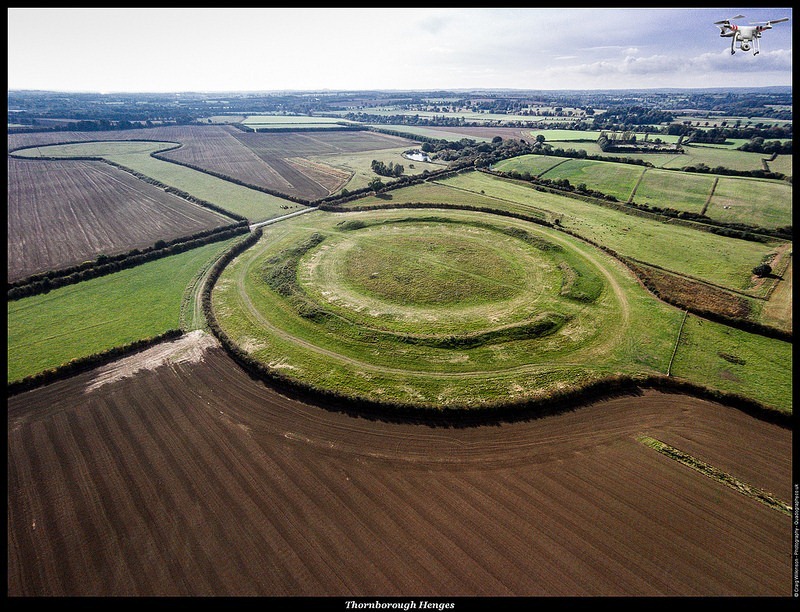
It was only while reading Home by Francis Pryor, that I found a possible answer. Francis had been working on a Neolithic causewayed enclosure site in Etton along with his wife. The enclosure was part of a complex of enclosures, like Salisbury Plain, and comprised a single circuit of interrupted ditches. They discovered, at the end of each ditch segment, objects which had been carefully placed there. The deposits in the segmented ditches were laid in layers, each protected by a birchbark mat, which would have been naturally waterproof. Intact pottery vessels, turned upside-down, skulls, and broken quern stones, for the grinding of grain into flour, were also placed in layers in the ditches.

According to Prior, the objects placed within the ditches were crafts traditionally carried out by women: pottery, weaving, bread-making, etc. That makes me wonder why they deposited these particular objects in the ditches? Was the site traditionally viewed as female? Just as with the Cumbrian circle? The female energy was believed to reside in the earth, so it makes sense that if they wanted to ensure the positive flow of energy into their own home and tribe they would make offerings of gratitude for the resources already received and the petition for that flow to continue for the coming year.

Within the henge, there were also multiple pits filled with ritual deposits, but the most striking thing for me was that in the ditches on either side of the causeways, quern stones had been placed on their sides, so that they stood upright. Stones were placed on either side of the causeway, of which there were possibly four, oriented North, South, East and West, although the South entrance was subsequently destroyed. The deposits seem to have been placed, on separate occasions, but in the same place each time, in layers, perhaps during large gatherings, and by kin groups. Each time they gathered, they carried out ceremonies and a new stone was placed there; again on its side so that it stood upright, but above the buried layer of the previous celebrations.
Grain was an important part of their survival and the excavators of Etton discovered evidence that “cereal crops were both grown and processed within the immediate vicinity, perhaps within the enclosure.”

When I read this for the first time, it immediately reminded me of my visit to Cumbria. and the importance of the stone circle in charging the wheat for the following growing season. The deposition of saddle querns, upright in the ditches, signalled for me the mental leap made by the Neolithic communities from ritual deposits of stones for wheat-grinding to standing stones. Wheat was such an important part of their survival that it stood to reason that the objects associated with grain processing should be held in such sacred esteem. I imagine, through the deposition of these stones, each family was both manifesting their food for the coming year but also giving something back to the Mother, in gratitude for feeding them; for taking care of them. And, as the quote above suggests, if the site was used for the processing of wheat, then corn rituals might well have been carried out in the centre too, creating what later became, the stone circles.
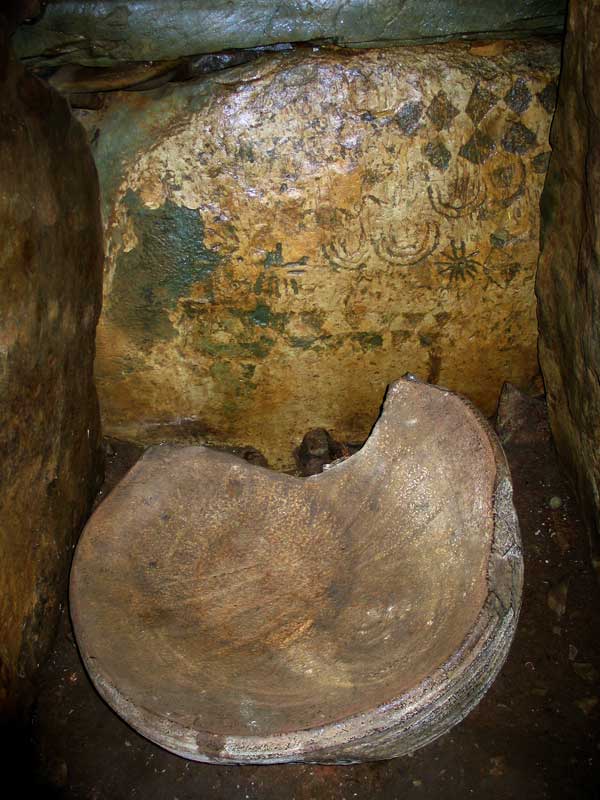
In Knowth, there is the huge concave stone in one of the recesses within the burial mound. Burial mounds represent the womb of the Mother. Knowth is part of the Newgrange complex, where the sun enters the chamber at Midwinter, to light up the darkness within. Again the solar rays fertilising the Mother. The large concave stone is like a huge ceremonial saddle quern and may well symbolise the fertilising of the grain. A gift to the mother and holder of the ashes of people who may have been the ones who carried out the sacred ceremonies.
The carving inside the stone is interesting too: To me, it looks like an energetic representation of the solar rays fertilising the seed within the womb of Mother Earth.

Of course, it may have had multiple meanings. As modern humans, we see symbols as representing things we only have understanding of ‘in the present’. We see things one-dimensionally. Our ancestors may have had access to knowledge we can only imagine, or re-learn, as we work in the energetic landscapes of the Mother.
The positioning of the saddle querns in the site in Etton also made me think of Mecca, where before Islam, tribal communities gathered there yearly. Each tribe had its own stone statue representing the energy of their tribe, their over-ruling deity, part of a circle of stones around the sacred site. Only with the coming of Islam was this practice destroyed and now only the ruling family have their ‘stone’, contained in the Kaaba. (Mecca had been a sacred site for many centuries, sacred to a triple goddess. One of these goddesses, Al-Uzzah, was a grain goddess).

As I was writing this, I found this very interesting article: https://www.hunebednieuwscafe.nl/2017/10/british-stone-circles-were-used-for-parties/ The article states: The research into the Ring of Brodgar also showed that each stone comes from a different part of the Orkney Islands. Apparently, each of the diverse groups of people brought its own stone and placed it in the monument. Remarkably, Professor Bayliss’ research also found evidence that people travelled to the Orkneys from as far away as Belgium. This fits very well with the idea of family groups/tribes having their quernstone in the circle.
Many ancient Mother/Goddess sites were symbolic womb; places where, at certain times of the year, the energies of fertility were strongest. The midwinter ritual of the sun piercing the darkest recesses of burial mounds, and temples, were fertility processes: the male sun sending his fertilising principle into the dark womb of the Mother to activate the egg waiting there. These were no empty rituals, however. Our ancestors understood the active energies that revitalised the energy lines in the earth, that brought new vitality after the dark of winter, warming the earth; bringing new growth. Where energy flows, so too does life.
There are naturally powerful places on earth where the energy is palpable, such as volcanos, places where crystals have formed, and deep underground caves. Places too where elemental energies are strong: rivers, lakes, mountains, and forests. But energy is also built through ritual and intention. I have never been a ‘ritual’ worker. I never really understood the purpose of ritual except as a focus for creating and for intention. But, I recently had an experience in a Cathedral Church in Arundel where I saw the result of ritual actions on the energy of a place over time.
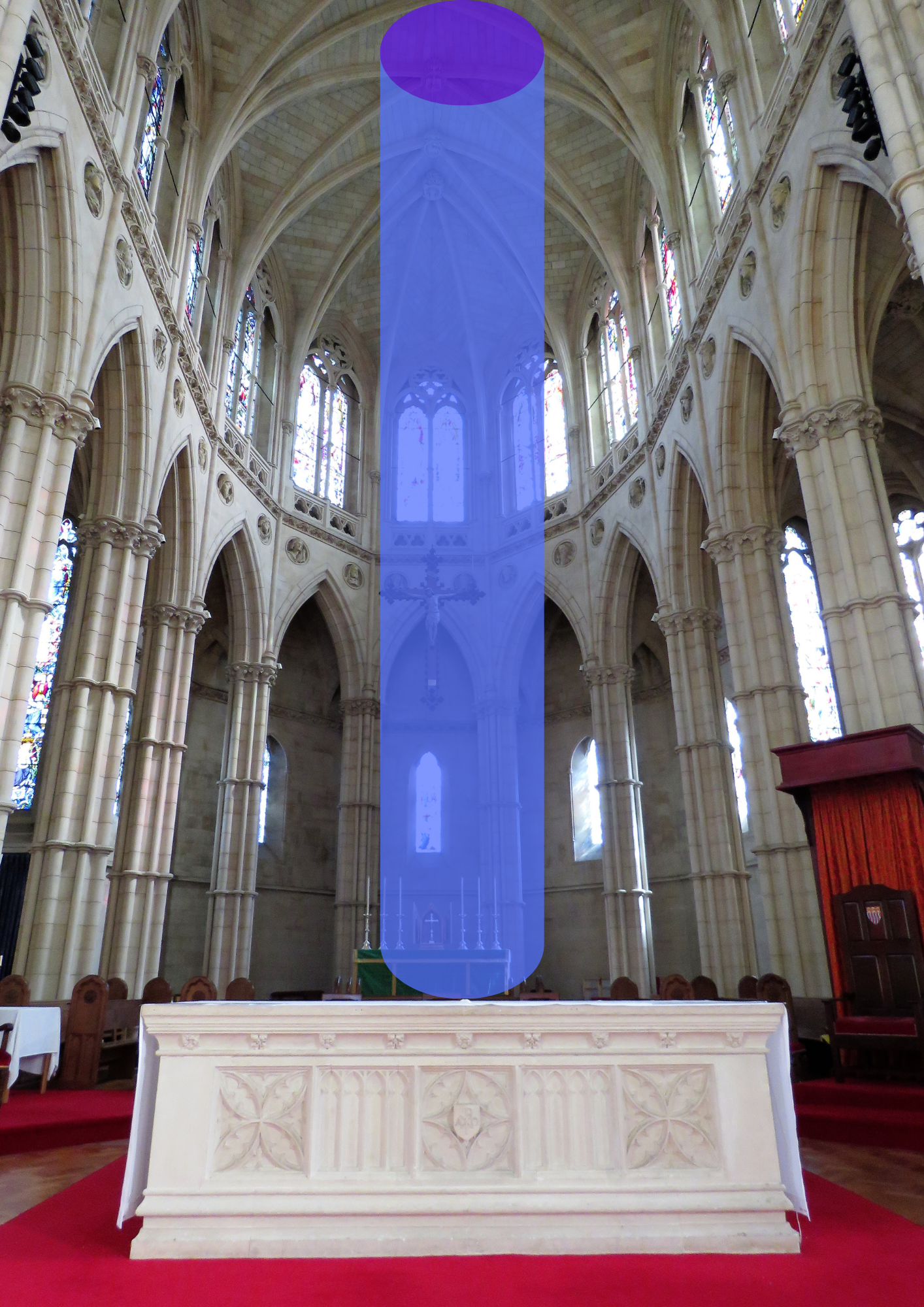
We were working on making a triangular connection between the sea and the river Arun. I wasn’t sure where this connection was supposed to be anchored but we went into the cathedral, just in case. I had been given water energy by a wonderfully loving sea elemental on Littlehampton beach and although I knew I had to put it somewhere; I didn’t know where, until it happened. As I approached the altar, which was built on top of an ancient spring, I saw the blue column of light behind it, which had been built up over the years by the priests doing the bread and wine ritual. This was a surprise to me. The energy had built up over so many years and had created a healing channel in the cathedral. This is also where the water energy gift was anchored, which was also a huge surprise. (One of the important things to remember when doing energywork is that religious belief plays no part. It is the positive intentions to help humanity which are important. Although saying that, the ancientness of the catholic ritual contains an energy that I have not found in other, more modern religious rituals).
But this ritual also involves the energising of bread, just as the ancient ritual in the stone circle Cumbria showed. (I think the energising of the wine might have been Roman in origin and added later as patriarchal religions became more prominent. The wine is energised from ‘above’ whereas the bread should be energised by the mother-energy ‘below’).
So that brings us back to the quernstones. We know that causewayed enclosures were the forerunners of stone circles so if the quernstones were placed as sacred objects and connected to a particular kin-group, (as in old Mecca, and Orkney), then it is not such a stretch to see that the later ‘standing stones’/quernstones in a circle came to represent each kin-family’s offerings to the Mother Goddess. The rituals building up over time gave these places their sanctity but there may well have been an extant ‘energy’ that told them where to build these sites in the first place.
The alignments of the main causeways appear to be directional, and the east/west entrances align with the sun. (We have often found main energylines crossing over in these sites, although not necessarily NSEW aligned). The astrological alignment aspects of stone circles might have come into play as a way for them to be sure about the timing of important events. I’m sure the simple beginning of the ritual circles became more complicated over time.
A very good book which explains how Glastonbury abbey was created is: The Gate of Remembrance by Frederick Bligh Bond, F.R.I.B.A. It is a book about the discovery of The Edgar Chapel through automatic writing and gives very interesting energetic information on how a sacred site is created.
Here are some more links for information.
https://www.lakedistrict.gov.uk/visiting/things-to-do/historical-places-to-visit/stone-circles




 The Gaia Method Earthways